Buy the Sovol SH03 Filament Dryer: it splits into two independently controlled chambers with their own heaters, so nylon can sit at one temperature while PETG dries at another, and all four spools can print live from inside. Filament pulls water out of the air, and the prints report it before you notice anything else: stringing that was not there last month, popping and hissing at the nozzle, layers that peel apart when you flex the part. A filament dryer is a heated, ventilated box that drives that moisture back out, and on every model here you can keep printing from inside the box so the spool never reabsorbs what you just removed. The right one depends less on brand than on what you actually run — one spool or four, a standard 1kg roll or an oversized one, and whether your materials need real heat or just a steady 50C. These five cover those cases without much overlap.
| Model | Maximum drying temperature | Spool capacity published | Rated power | Published noise figure |
|---|---|---|---|---|
| Sovol SH03 | 45–85 °C | Four rolls up to 70 mm wide, or two up to 150 mm wide | 400 W | Below 50 dB |
| SUNLU FilaDryer S2 | Up to 70 °C | Not published | 48 W | Less than 10 dB |
| EIBOS Polyphemus | 30–80 °C | Two spools 210 mm dia. × 80 mm, or one 210 mm dia. × 170 mm; 250 mm dia. × 170 mm with the expansion kit | 130 W | Not published |
| Polymaker PolyDryer | Not published | 205 mm dia. × 78 mm, filament with spool | 68 W | Not published |
| SUNLU FilaDryer E2 | 35–110 °C | 250 mm dia. × 153 mm: two 1 kg spools, two 2 kg, or one 3 kg | Not published in watts; the sheet gives 4.2 A at 120 V | Not published |
Best Overall: Sovol SH03 Filament Dryer
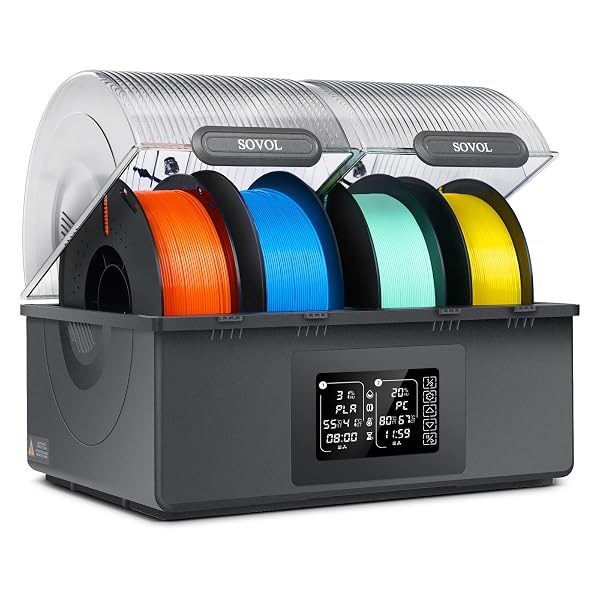
The SH03 is the one to buy if you only want to buy one. It splits into two independently controlled chambers, each with its own 200W PTC heater and its own temperature setting across a 45C to 85C range, so you can hold nylon at 75C on one side while PETG sits at 55C on the other — something no single-chamber box can do without you babysitting it. Four 1kg spools fit, two per side, and PTFE-lined feed-through ports let all four print live without breaking the seal. The auto-dehumidification routine watches the internal humidity rather than just running a timer, dropping into a low-power storage mode once it hits target and waking back up when the reading drifts. The tradeoffs are physical: it is a wide box that wants real shelf depth, each spool bay caps out around 70mm of width so a few oversized or chunky cardboard spools will not seat, and at 85C it stops short of what carbon-filled PA and polycarbonate really want.
Best Budget: SUNLU Filament Dryer S2
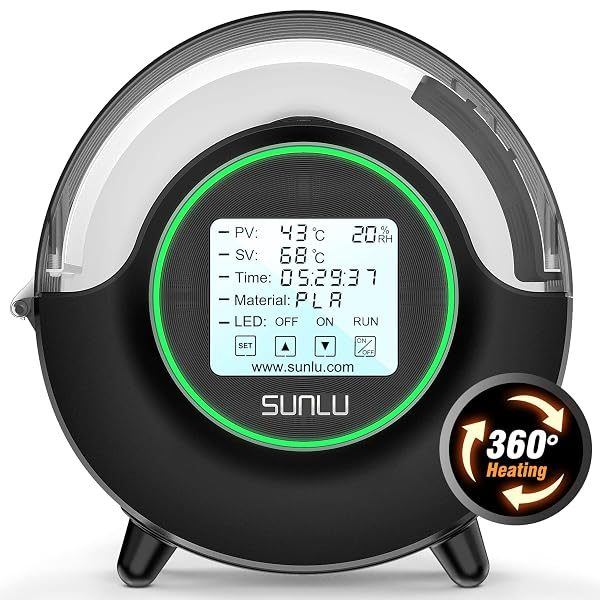
The S2 is the unit the maker forums have defaulted to for years, and it earns that by being unremarkable in the right ways. One spool, 360-degree heating up to 70C, a timer that runs long enough for an overnight cycle, a touchscreen that shows temperature and internal humidity rather than just a heat setting, and a filament exit port so the spool feeds the printer while it dries. The humidity readout matters more than it sounds: it is the only way to know a cycle actually finished instead of guessing from the clock, and plenty of cheaper boxes omit it. SUNLU’s page publishes one temperature, a 70C maximum. Nobody publishes how the seal holds up after a year of cycles. What you give up is capacity and ceiling — one spool at a time, and 70C is where it stops. SUNLU calls the S2 suitable for PA and PC, then sells a second dryer rated 90C for those two. Polymaker asks 75C to dry PC, 80C for nylon and 100C for PA6-CF. For PLA, PETG, ABS and TPU, which is most people most of the time, it is enough.
Typically: $40–$50 | Check current price on Amazon
Best for Large Spools: EIBOS Polyphemus Filament Dryer
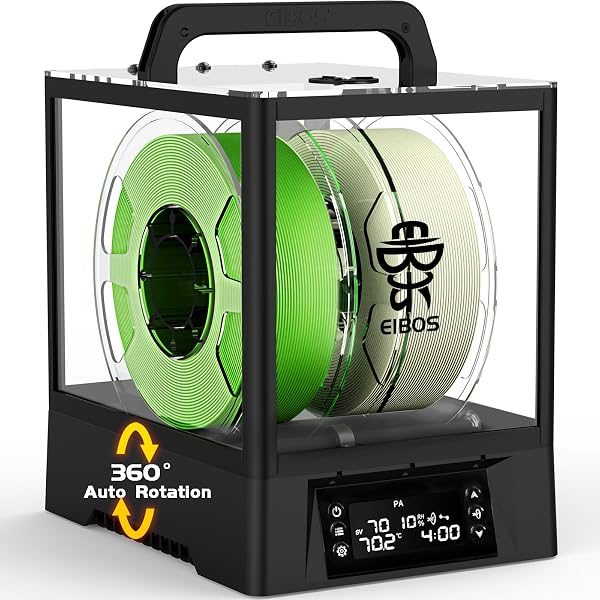
Most dryers are built around a 1kg spool and quietly stop there, which is a problem if you buy filament in 2kg or 3kg rolls to cut cost per kilo. The Polyphemus is sized for those: one 3kg spool fits, or two standard 1kg rolls side by side, with 360-degree heating to 80C. Its real trick is rotating the spool during the cycle. On a big roll the outer wraps dry long before the core does, and static drying leaves the inside of a 3kg spool damp after a cycle that looked complete from the readout; turning the spool puts every layer through the same airflow. It also holds a humidity target rather than just a temperature, so it settles into maintenance mode instead of cooking. The costs are a motor that is one more thing to eventually fail, a footprint to match the spools it takes, and a little more noise than a fan-only box because something is physically turning.
Two makers here put a decibel number in their page copy. Neither prints it as a spec row. Neither names a test standard.
The box this list calls quietest publishes no figure at all; a blank spec sheet changes how we rank.
Quietest: Polymaker PolyDryer
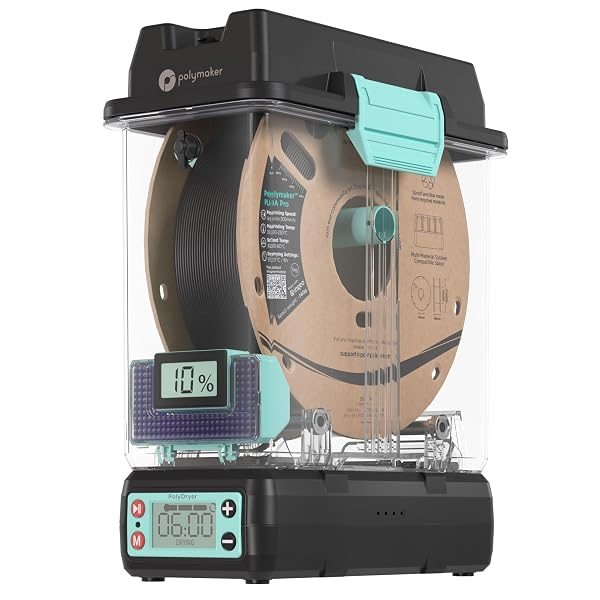
A filament dryer is not a thing you run for twenty minutes — a proper nylon cycle is eight to twelve hours, and if the printer lives on your desk or in a bedroom that is eight to twelve hours of fan. Polymaker publishes no decibel figure. The ranking rests on the design: a tighter sealed chamber needs less air movement to hold its target. The seal is the best part of the design regardless of noise: it keeps the enclosed humidity low enough that the box doubles as real storage between prints rather than just a dryer, with a top-mounted hygrometer you can read without opening anything. The chamber is modular, so extra boxes can be swapped onto the same heated base as your filament collection grows. Against that, it takes one spool, and Polymaker publishes no drying temperature for it at all. The company’s own filament guide sets the PolyDryer by power level, one to three; there are no degrees on it anywhere.
Typically: $60–$80 | Check current price on Amazon
Best for High-Temp Filaments: SUNLU E2 Filament Dryer
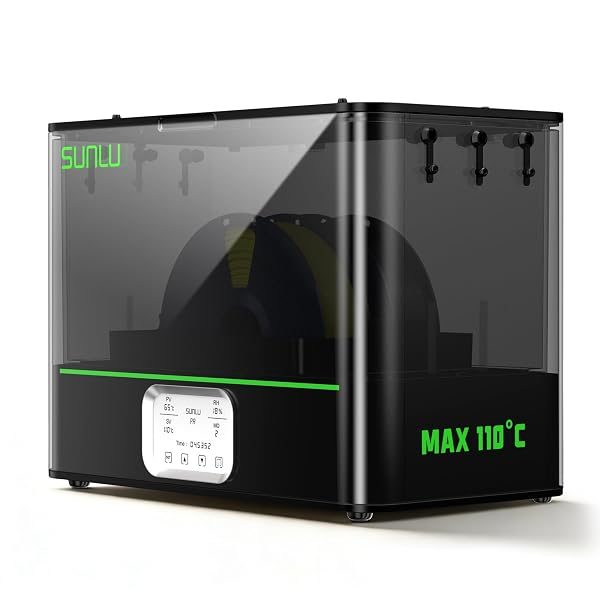
Everything above stops between 70C and 85C, which is fine until you run carbon-filled nylon, polycarbonate or PPS and find the manufacturer’s drying spec sitting above the ceiling of your box. The E2 goes to 110C on a 500W PTC heater across two chambers, which puts those materials properly in range instead of nearly in range, and it adds an annealing mode that heat-treats finished parts to relieve internal stress and raise their heat deflection temperature. That is a second machine’s job being done by the dryer, and it is the reason to pick this over a cheaper box if your parts are functional rather than decorative. It is also the reason not to: 500W and a 110C ceiling are pure overhead if you print PLA and PETG, it draws meaningfully more power than a 50W single-spool unit, and running PLA anywhere near its upper range would destroy the spool. Buy it for the materials, not the spec sheet.
Typically: $225–$300 | Check current price on Amazon
The single most useful thing to know about drying is that the temperature dial is bounded by the filament’s glass transition point, not by what the box can reach. PLA softens somewhere around 55C to 60C, so a dryer set to its 70C maximum will not dry a PLA spool faster — it will soften the windings, let them press into each other under spool tension, and hand you back a roll that binds or snaps mid-print. PLA wants 45C to 50C. PETG sits around 65C, ABS and ASA around 70C to 80C, nylon 70C to 80C for eight to twelve hours because it absorbs more water and holds it harder than anything else in common use. The second thing worth knowing: drying is not a one-time fix. Nylon and TPU pull enough moisture back out of the air to matter within a day or two of sitting open once ambient humidity is above roughly 50 percent, which is why print-through ports and a sealed storage mode end up being the features you actually use, rather than the peak temperature you bought the box for.
Leave a Reply