For an ordinary open suburban lawn of about a quarter acre the Segway Navimow i110 Robot Lawn Mower is the answer, provided you have somewhere with a clear view of the sky to put its RTK antenna. The buried boundary wire is essentially over. Every machine worth buying in 2026 maps your lawn from an app instead, and the real question is no longer whether to dig a trench but which navigation system suits your yard: an RTK antenna that needs a clear view of the sky, network RTK that skips the antenna, or 360-degree LiDAR that ignores satellites altogether. Get that choice wrong and you get a mower that wanders, stalls, or gives up under a big maple on a cloudy afternoon. These five cover the situations most people actually have, and each one is here for a different reason.
| Model | Positioning system published | Maximum lawn area published | Maximum slope published | Cutting width |
|---|---|---|---|---|
| Segway Navimow i110 | EFLS 2.0 | 0.25 acre, recommended mowing area | 30% (17°); 10% (6°) at the boundary | 7.1 in |
| Sunseeker S4 | 360° 3D LiDAR + AI Vision (L-SLAM + V-SLAM); antenna listed as N | 0.25 acre | 42% / 22° | 7 in |
| Mammotion LUBA 3 AWD 3000 | Tri-Fusion: 360° LiDAR + NetRTK + dual-camera AI vision | 0.75 acre | 80% (38.6°) | Not published |
| AIRSEEKERS TRON SE | VSLAM + NetRTK | 1,500 m² (0.37 acre), optimum area | Working grade ≤60% (31°); driving grade ≤65% (33°) | 220 mm (8.66 in) |
| MOVA LiDAX Ultra 2000 | UltraView 2.0: 360° 3D LiDAR + AI Vision | 0.5 acre, maximum mapping area | 45% (24°) | 7.9 in |
Best Overall: Segway Navimow i110 Robot Lawn Mower
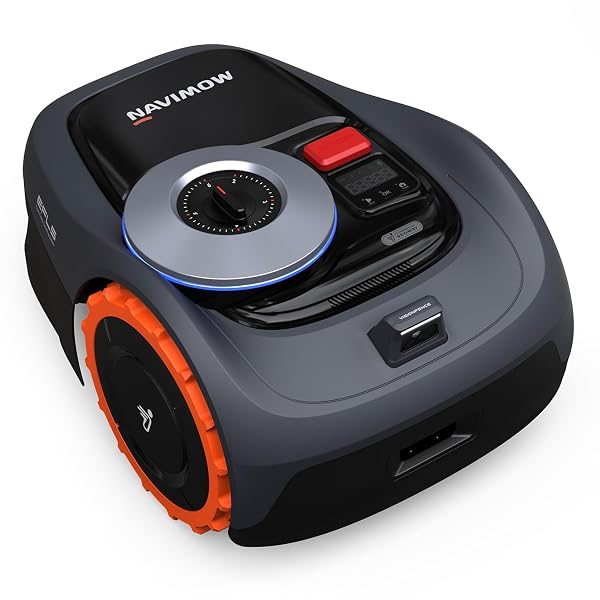
For an ordinary open suburban lawn of about a quarter acre, the Navimow i110 is still the machine that produces the fewest surprises. Segway pairs a mast-mounted RTK receiver with a forward camera, so the mower knows where it is to within a couple of centimeters and can also see a hose or a sleeping dog in front of it. You map the lawn by driving it around the perimeter once in the app, set no-go zones around beds, and it cuts in tidy parallel passes rather than the random bouncing older wire mowers used. The app is the most mature in the category, and Segway has been shipping firmware fixes long enough that the early mapping bugs are gone, which is not something you can say about most of the brands that appeared in the last eighteen months.
The tradeoff is the antenna, and it is a real one. Segway puts an antenna location finder in the app because the base has to go somewhere with a clear view of the sky, and it sells a 10 m antenna extension cable for the i1 Series because that spot is often nowhere near the dock. Segway does offer an antenna-free setup elsewhere in the range; the i Series is not part of it. If the only place you have is tucked under the eaves or against a tree line, the i110 is the wrong machine and one of the LiDAR picks below is the right one. The cutting width is modest, so a full quarter acre takes more than one session, but it mows every day and nobody has to watch.
Typically: $950–$1,250 | Check current price on Amazon
Best for Small Yards: Sunseeker S4 Robot Lawn Mower, 3D LiDAR, Vision AI, 0.25 Acre
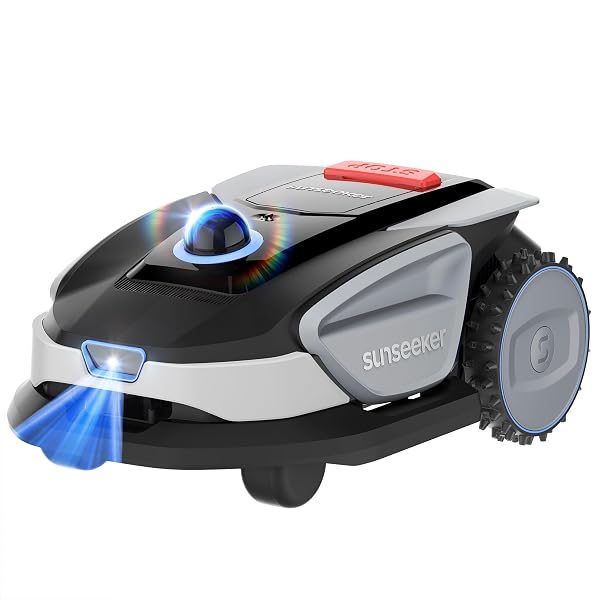
Small lawns are harder for robot mowers than big ones, because everything is an edge: a path, a bed, a bin store, a fence three feet from the house wall. The S4 is built for exactly that shape of problem. It is physically small with a narrow cutting deck, so it fits down the side return and between raised beds without wedging itself, and it navigates on 360-degree LiDAR plus a camera rather than RTK, which means there is no antenna to site and no perimeter walk at all. You let it explore, it builds the map itself, and you tidy the boundaries in the app afterward. It is quiet enough to run while you are sitting outside. The honest limits are slope and grass condition: the small wheels give up well before the all-wheel-drive machines do, so anything steeper than a gentle bank will beach it, and it is happier on grass kept short than on a fortnight of growth. If your lawn is flat, fiddly and under a quarter acre, that is a fair trade for a mower that needs no infrastructure whatsoever.
Typically: $850–$1,150 | Check current price on Amazon
Best for Slopes and Complex Lawns: Mammotion LUBA 3 AWD 3000H Robot Lawn Mower
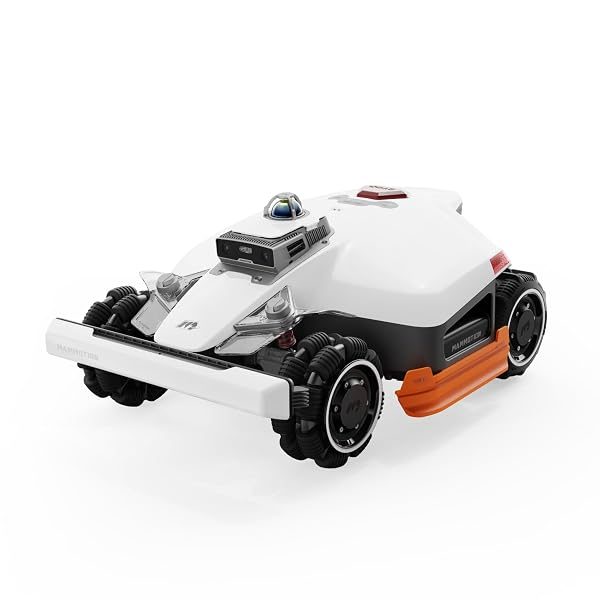
This is the one to buy if your lawn has banks, terraces, or three separate areas joined by a narrow strip of grass. The LUBA 3 is all-wheel drive with genuinely aggressive tires and a rated climbing ability around 80 percent grade, which in practice means it walks up embankments that would leave a two-wheel-drive mower spinning and cutting a bald patch. Mammotion stacks three positioning systems on top of each other, LiDAR plus network RTK plus camera vision, so when one drops out under a tree the others carry it and it keeps mowing in straight lines instead of falling back to random mode. It handles multiple zones properly, driving itself between them along routes you define, and it covers up to about three quarters of an acre. Two things to know before you commit. It is heavy and powerful enough to scuff turf on tight pivots, especially on newly laid or soft ground, so dialing back the turning style in the app is worth doing early. And it is by a wide margin the most expensive machine here. On a flat rectangle that money is wasted; on a sloped or awkward property it is the difference between a robot that works and one that lives in the shed.
Typically: $2,400–$3,200 | Check current price on Amazon
Best Budget: AIRSEEKERS TRON SE Robot Lawn Mower, Wire-Free, Up to 0.37 Acre
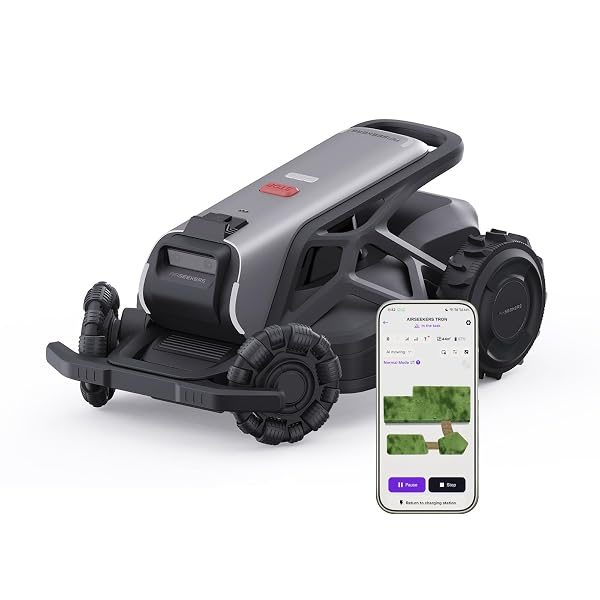
The TRON SE is the cheapest machine in this roundup that still does the thing people actually want, which is mow a real lawn with no buried wire and no antenna mast bolted to the house. It uses network RTK, pulling its correction signal over the internet instead of from a local base station, so setup is genuinely quick and there is no pole to find a home for. It covers a bit over a third of an acre, climbs a respectable 65 percent grade, and the camera-based obstacle avoidance is good enough to stop for a garden hose. Reviewers who have run it alongside the flagships consistently find the cut quality fine and the app perfectly usable. What you give up is margin for error. Network RTK depends on a decent cellular or Wi-Fi signal reaching the mower, and in the far corner of a large plot it can lose the thread and simply sit there waiting. It is also more prone than the pricier machines to stranding itself on an obstacle it half-climbed. If your lawn is flat, well covered by your network, and you want to find out whether a robot mower suits you before spending flagship money, this is the sensible way in.
Typically: $750–$1,000 | Check current price on Amazon
Best for Shaded, Tree-Heavy Lawns: MOVA LiDAX Ultra 2000 Robot Lawn Mower with 4G, 0.5 Acre
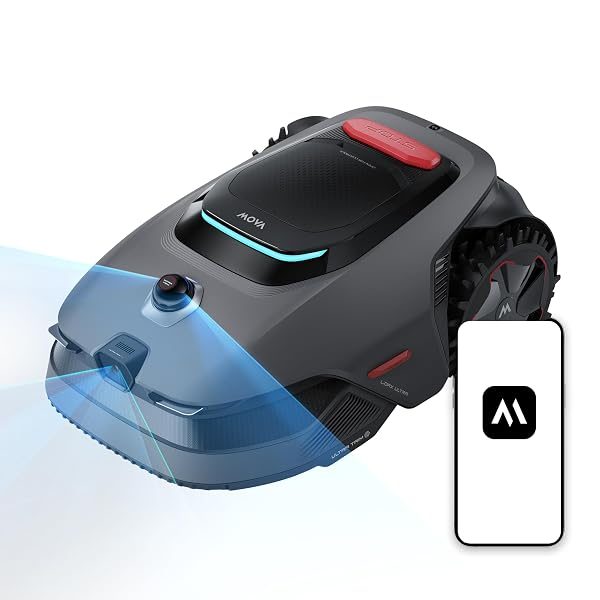
Mature trees are what break RTK mowers. A dense canopy blocks enough satellites that the fix drops in and out, and the mower either slows to a crawl, pauses, or drifts off its line until it recovers. The LiDAX Ultra 2000 sidesteps that entirely by using no satellites at all: a spinning 360-degree LiDAR builds a three-dimensional model of the garden and the mower navigates against physical landmarks, the way a robot vacuum does indoors. There is no wire, no antenna, and no correction service to depend on, and because LiDAR does not care about light levels it works just as well in deep shade or at dusk as it does at noon, which is more than camera-only mowers can claim. It covers up to about half an acre, edges better than most machines near its price thanks to a deck that slides sideways over the boundary, and independent testers have been unusually consistent in praising how confidently it navigates. The weak point is the running gear rather than the brain: the front casters struggle on soft, sandy or badly rutted ground, and it is not a slope machine. On a wooded but reasonably level plot, it is the most dependable navigator here.
Typically: $1,000–$1,400 | Check current price on Amazon
The slope figures are the giveaway. Each maker labels that number its own way; none names a test standard. Untangling that is the work we think is worth doing.
The spec that decides whether you are still happy a year from now is not the advertised mowing area, it is where the positioning signal comes from and whether your garden can actually supply it. An RTK machine is the most accurate option available and will cut dead-straight stripes, but the antenna needs a genuinely clear view of the sky, roughly the siting a satellite dish wants, and people routinely bolt theirs to a fence post under a tree and then blame the mower. Network RTK removes the antenna but substitutes a dependency on signal reaching every corner of the plot. LiDAR removes both and is the only approach completely indifferent to canopy and cloud, at the cost of being newer and, so far, fitted mostly to machines that are not built for steep ground. Work out which of those three your garden can support before you compare anything else, because no amount of cutting width or battery capacity rescues a mower that does not know where it is. And treat quoted mowing areas as a ceiling rather than a schedule: real throughput on a garden with beds, trees and narrow links between zones is commonly half the headline figure, so size up rather than down if you are anywhere near the limit.
Leave a Reply