If the toy has to disappear in a meeting, the PILPOC theFube 6-Sided Fidget Cube is the one to get: four of its six sides are built silent, and it ships with its own carry case. Fidget toys look interchangeable in a five-pack thumbnail, but the right one depends on three things that have nothing to do with price: how loud it is, how old the person using it is, and what kind of movement actually settles them — twisting, squeezing, clicking, or something with no moving parts at all. Get any of those wrong and the toy ends up in a drawer within a week. Here’s what each of these five actually is, not just what the listing says it is.
Quiet Enough for a Meeting or a Classroom
A fidget toy that clicks is a liability in a meeting or a quiet classroom, no matter how good it feels in the hand. If it needs to disappear into the background, check what its mechanism actually does before buying — ‘stress relief’ marketing copy rarely mentions the sound. Checking the mechanism rather than the marketing copy is most of the method here, and How We Pick sets out the rest.
For Quiet Fidgeting in Meetings or Class: PILPOC theFube 6-Sided Fidget Cube
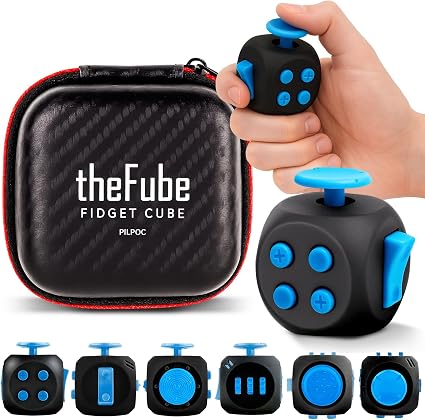
The theFube is a 6-sided cube where four of the six sides are built silent — flip switches and rolling joysticks with no click — leaving one side audible, the Switch, and one that PILPOC describes as partly silent and partly audible, for when quiet doesn’t matter. It ships with its own carry case, which is the detail that actually matters for a meeting-room pick: somewhere to drop it so it doesn’t rattle loose in a bag or pocket between uses. It’s the wrong pick for someone who specifically wants the clicking feedback — most of this cube is built to be felt, not heard.
Typically: $13–$17 | Retailer: Amazon
Twist-and-Squeeze Types Built for Adult Hands
Two different mechanisms fall under ‘fidget with it in your hand’: a segmented toy you twist and loop, and a solid-squish toy you press and let ease back into shape. Neither depends on batteries or a click mechanism — the difference is just which motion actually settles you, turning something over versus squeezing it.
The Straightforward Squeeze: Schylling NeeDoh Nice Cube
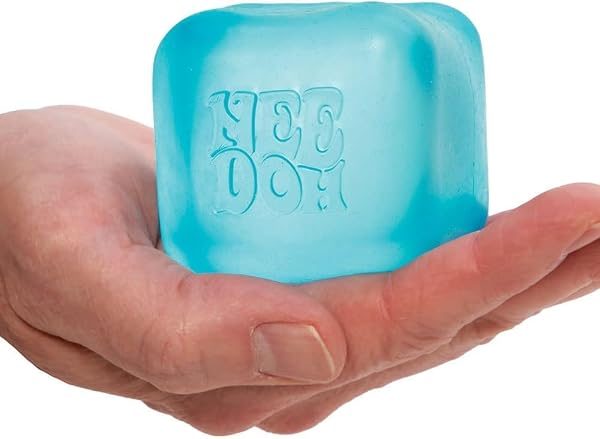
This is Schylling’s NeeDoh Nice Cube, a cube version of the brand’s squeeze toy sold one per package. Schylling gives its size two different ways on the same page, 2.25 inches square in the description and 2.375 by 2.375 inches in the specification table, and describes the filling as a non-toxic, dough-like compound that holds its shape over thousands of squishes. It comes in three assorted colours and Schylling supplies one at random, so there is no way to request a specific shade before it ships.
That’s worth flagging on a gift-oriented list — if the recipient cares about matching a specific color, order something else; this one arrives in whatever color the warehouse happens to pull. Beyond that, treat it as a straightforward squeeze-and-release fidget: something to press and let ease back into shape, not something with a mechanism to click, twist, or spin.
Typically: $8–$11 | Check current price on Amazon
For Kids Who Need Constant Motion: Tangle Jr. Classic
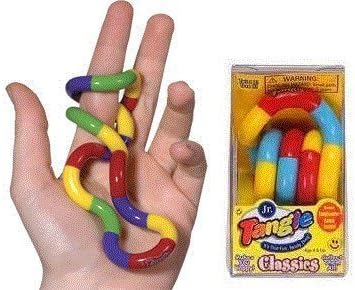
The Tangle Jr. is eighteen 1-inch curved segments locked into a loop that coils down to about 1.5 by 2 by 1.5 inches and stretches to roughly 7 inches when straightened out. There’s no filling to leak and nothing to pop — the segments just rotate against each other, which is the point for someone who fidgets by twisting and reshaping something rather than squeezing it. Because the segments can separate, the manufacturer flags it as a choking hazard for children under 3; it’s the wrong pick for that age group no matter who else in the house it’s bought for.
Typically: $13–$17 | Retailer: Amazon
The One Mechanism With a Real Hazard: Loose Magnets
Small magnets are the one mechanism on this list where the risk is not durability or noise but what happens if a loose piece is swallowed. That is worth knowing before this ends up on a shared desk or coffee table.
For the Executive Desk: Speks Supers Magnetic Sensory Balls
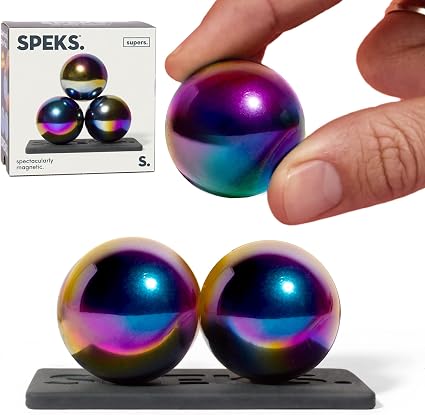
These are heavy ferrite magnet balls, 1.25 inches across on Speks’ own figure, sold in a three-pack and a six-pack, and functional as both a desk sculpture and a hand fidget: pull them apart and they snap back together. Speks lists LOUD among the features, so this is the opposite of the meeting-room pick above, and it recommends keeping them away from laptops, credit cards and hard drives. The product page itself carries one caution, that the balls may pinch small fingers and should be kept away from children, and no age grade at all; there is a separate safety page we were unable to read, so treat that as the product page being brief rather than as the whole of what Speks says. Give loose high-powered magnets more care than one line about fingers implies: the hazard is swallowing two of them, because they can then pinch tissue between them from opposite sides of the gut. If there is any chance a young child gets hold of a loose one, this is the wrong pick, regardless of whose desk it sits on.
Typically: $17–$23 | Retailer: Amazon
The Youngest End: Under a Year
Everything else on this list assumes hands big enough to twist, squeeze, or flip something. Fidget toys for babies work on a different mechanism — cause and effect — and the safety bar is correspondingly different: nothing that separates, nothing smaller than a fist.
For Babies and Toddlers: Fat Brain Toys Original Dimpl
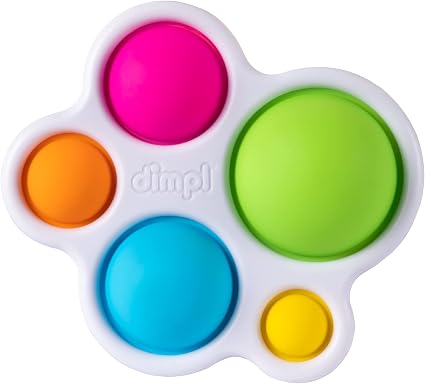
The Dimpl is five silicone bubbles of different sizes, each pushed in from one side and popping back out the other, built, as Fat Brain puts it, safely into a sturdy, rigid frame of high-quality ABS plastic. It’s rated for 10 months and up, and the bubbles are food-grade silicone — which matters more here than on any other pick on this list, given how much time it’ll spend in a baby’s mouth. It’s a poor fit for the rest of this list’s audience: there’s no twisting, clicking, or squeeze-and-release tension to it, just the pop.
Typically: $8–$11 | Retailer: Amazon
What the makers publish, and what they do not
Every figure below is the manufacturer’s own, copied from that brand’s own product page. Where a cell reads “Not published”, that page does not state it. It is a fact about the page, not a verdict on the toy, and it is not a claim that the maker has never said it anywhere else.
| Toy | Dimensions | Material | Pieces in the package | Age and safety statement |
|---|---|---|---|---|
| PILPOC theFube | Not published | Silicone rubber buttons; body material not named | Single unit, with a protective case | Not published |
| Schylling NeeDoh Nice Cube | 2.25 in square in the description; 2.375 × 2.375 in in the specification table | Filled with a non-toxic, dough-like compound that holds its shape over thousands of squishes | One cube per package, one of three assorted colours, supplied at random | Ages 3+; choking hazard, small parts, not for children under 3 yrs.; do not heat, freeze or microwave |
| Tangle Jr. Classic | 1.5 × 2 × 1.5 in coiled; extends to 7 in uncoiled | Not published | Eighteen 1 in curved sections | Choking hazard for children under 3 because the sections separate; no age grade published |
| Speks Supers 6-Pack | 1.25 in diameter per ball | Ferrite magnets, described as heavy with a super smooth, polished surface | Set of 6; Speks also sells a 3 pack | Caution, balls may pinch small fingers, keep away from children; no age grade on the product page |
| Fat Brain Toys Original Dimpl | 5.5 × 5 × 1 in | Frame of high-quality ABS plastic; bubbles of 100% food-grade silicone | Five silicone bubbles in one frame | Manufacturer recommended minimum age 10 months; no safety warning published |
One of these pages disagrees with itself, so both of its figures are printed rather than a pick between them. Schylling calls the Nice Cube 2.25 inches square in its description and gives 2.375 by 2.375 inches in the specification table on the same page. An eighth of an inch changes nobody’s buying decision, but printing one number and quietly dropping the other would invent a precision the maker has not published.
Noise is the reason most of these get returned, and it is not in the table because only two makers address it and they are not saying comparable things. PILPOC is specific, and describes a per-side split rather than a quiet toy: four silent sides, one audible side, the Switch, and one that is partly silent and partly audible, with two of its four buttons silent and two audible. Speks goes the other way and lists LOUD as a feature of the set, alongside heavy and smooth. Everyone else is silent on the subject, which is not the same as the toy being silent.
Weight is not a column because not one of these five publishes a weight, and Schylling prints the words Weight: N/A in its own specification table. Age and safety share a column because separately each would be mostly empty: two makers publish an age, three publish a warning, and four publish at least one of them. Where a cell gives a warning but no age, or an age but no warning, that is exactly what the page does.
One caution on reading that last column. The Speks cell describes the Supers product page, which carries a pinch warning and no age grade. Speks keeps a separate safety page, and nothing here should be read as a claim about what is or is not on it. The hazard with loose high-powered magnets is well established whatever a given page says: the danger is swallowing two of them, because they can then pinch tissue between them from opposite sides of the gut. Buy around that risk rather than around the wording of a warning.
Leave a Reply